
The Complete Guide
Danube Delta Floating Hotel
Europe's only live-aboard birdwatching hotel — inside the UNESCO Biosphere Reserve
What Makes a Floating Hotel Different
Most wildlife tours operate from a land base — a hotel in town, a guesthouse outside the reserve — and travel to the wildlife each day. This creates an unavoidable problem: the best wildlife moments happen at dawn and dusk, but the best hotels are in the nearest town, which may be 45–90 minutes from where the wildlife actually is.
A floating hotel solves this. The vessel repositions each night to a new area of the delta, anchoring near the locations scheduled for the following morning. When you wake at 5:30 AM for the first motorboat excursion, you are already there. No bus, no transit, no arriving after the best light has gone.
In the Danube Delta — where the most productive wildlife areas are 2–4 hours from Tulcea by boat — this is not a luxury. It is the only practical way to reach and properly experience the deep delta. Day trips from the port see the edges. The floating hotel puts you in the interior.
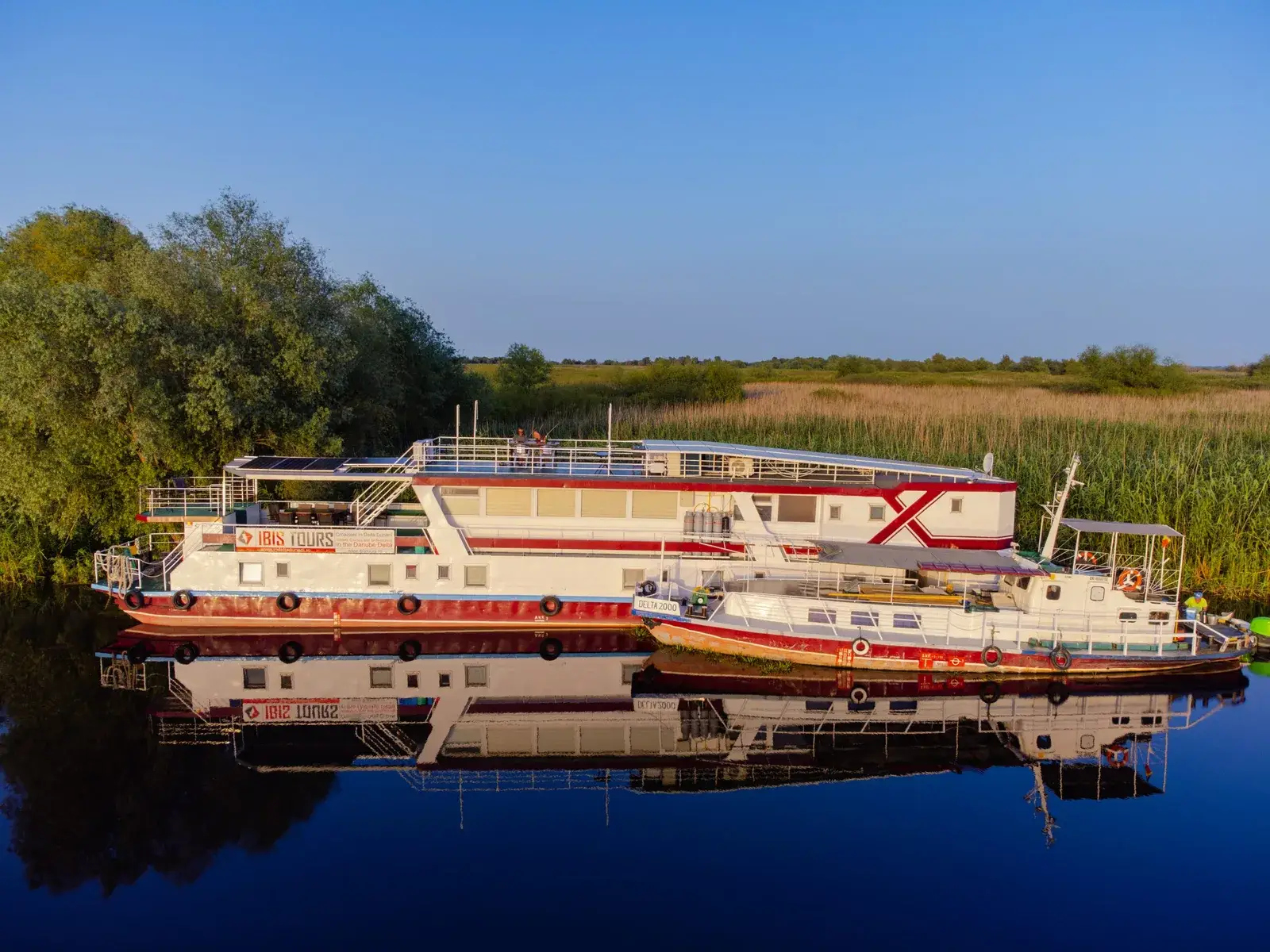
Ibis Tours has operated the only live-aboard wildlife hotel in the Romanian Danube Delta since 1995. This guide covers everything: the vessel, the cabins, the meals, a typical day on the water, and what to expect in each season.
Inside the Floating Hotel
Built for wildlife watching, not for sightseeing cruises. Every design decision reflects 30 years of understanding what guests need in the field.

10 En-Suite Cabins
All cabins have private bathrooms with shower, individually controlled air conditioning and heating, storage for clothing and equipment, and windows with delta views. Cabins are furnished as a good 3-star hotel room — comfortable, functional, not cramped. Bed configuration is double or twin depending on booking; please specify at reservation.
Maximum capacity is 20 guests. Groups rarely reach this number — the average cruise runs at 12–16 guests, which feels spacious on the vessel.
Panoramic Restaurant & Salon
The main deck salon has floor-to-ceiling windows on three sides — designed specifically to allow wildlife watching from inside in bad weather. Breakfasts here are a ritual: coffee, fresh bread, the delta sliding past the windows before the morning excursion. Dinners are served after the evening excursion returns, typically around 8:30–9:00 PM.
The menu is full board: breakfast, lunch (light — often eaten on the upper deck), and dinner. Romanian home cooking with good vegetarian options. Dietary requirements accommodated with advance notice.
Two Observation Decks
The upper sun deck sits 6 metres above water level — high enough for a commanding view over reed beds and open water that is simply not achievable from a low motorboat. This is the best platform for scanning with a spotting scope, for flight shots of passing raptors and pelicans, and for simply watching the delta life unfold around a stationary vessel.
The lower deck wraps around the bow and stern and is at water level — ideal for photography when the boat is drifting slowly in a channel, and for the social evenings that develop naturally as guests debrief the day's sightings over a glass of wine.
Motorboat for Excursions
Each morning and evening excursion uses the accompanying motorboat — a flat-bottomed craft with a quiet engine, low profile, and no raised superstructure that would block sight lines. It carries 8–12 guests depending on the excursion. The boat is optimised for delta channels: shallow draught, silent running at low speed, and a stable platform for photography.
The motorboat stays attached to the floating hotel during nights and midday rest periods. Spontaneous short excursions can sometimes be arranged with the guide if conditions are exceptional.
A Typical Day on the Floating Hotel
The rhythm of a delta cruise is governed by light and wildlife activity — not by tourist convenience. This is what makes it work.
Silent Wake-Up
A gentle knock. Coffee is ready in the salon. Outside, the delta is still dark but not quiet — Night Herons are calling from the willows, Bitterns booming from the reed beds. The motorboat is already running. You have 30 minutes before departure.
Dawn Motorboat Excursion
The first and most important excursion of the day. The boat enters the channels before full daylight and positions near pelican roosts, heron colonies, or open water favoured by duck flocks. As the sun rises — typically between 5:30 and 6:30 AM depending on season — the birds begin moving and the light turns from grey to orange to gold.
This is when photographers produce their best images. This is when the most unusual sightings occur. And this is the window that is simply impossible to access from a land base 2+ hours away.
Typical duration: 2.5–3.5 hours
Breakfast
Full breakfast in the panoramic salon. The morning sightings are discussed. The guide marks positions on the map. The vessel begins repositioning while guests eat — moving slowly through the channels toward the next area. Through the windows, the delta continues passing.
Mid-Morning Excursion
A second motorboat excursion targeting a different habitat — perhaps a large open lake for scanning duck rafts and distant eagle activity, or a narrow forested channel for Kingfishers, Rollers, and Bee-eaters. By 11:00–11:30 AM in summer, the light becomes harsh and birds become less active.
Typical duration: 1.5–2 hours
Lunch & Siesta
Lunch is served — typically lighter than dinner, often eaten on the upper deck if weather permits. The early afternoon is rest time: the guide's daily checklist is circulated, species tallies are updated, and anyone who wants to scan from the upper deck is welcome to. Sleep is not unusual and strongly encouraged before the evening excursion.
The vessel continues repositioning during this period, moving to the evening excursion area.
Afternoon Walk or Excursion
Where the itinerary allows — near Letea Forest or the Sulina beach — an afternoon land excursion provides a change from the boat. Letea Forest is the only place in the delta where you can walk through old-growth oak forest with Lesser Spotted Woodpecker, Middle Spotted Woodpecker, and Collared Flycatcher overhead. The beach at Sulina holds Kentish Plover and Little Tern in season.
Evening Motorboat Excursion
The second golden hour of the day. In summer, the light returns to low and warm at around 7:00–7:30 PM. The evening excursion targets different areas from the morning — ideally an open lake or colony edge — to take advantage of the warm backlit conditions and the peak activity of birds returning to roost.
Purple Herons flight-lining into the reed beds. Glossy Ibis flocks calling overhead. White-tailed Eagles making final hunting passes over the water. The evening excursion often produces the most memorable moments of the cruise.
Typical duration: 2–2.5 hours
Dinner & Debrief
A full dinner in the salon, followed by the informal debrief that becomes one of the rituals of every cruise. The guide leads a review of the day's highlights — rare sightings are confirmed, photographs are compared, tomorrow's itinerary is outlined. The day list typically reaches 60–90 species by this point on a good day in May.
Season by Season on the Floating Hotel
We operate April through October. Each month has a distinct character. Here is what to expect.
Spring: Breeding Colonies Active
The finest months on the delta. Pelican colonies have chicks from late May onwards — the morning flight of hundreds of adults returning with fish is one of the great European wildlife spectacles. Passage migrants are moving through in April and May, adding unexpected species to each day's list. Long days mean up to 16 hours of usable light.
May is consistently the single best month: breeding activity at its peak, migrants still present, mosquitoes not yet intense, temperatures warm but not hot. A May cruise regularly produces 150+ species over 4–5 days.
Summer: Long Days, Post-Breeding
High summer is hotter — 30–36°C at midday — but the floating hotel's air conditioning makes afternoon rest genuinely comfortable. The breeding season is drawing to a close but large post-breeding concentrations form: juvenile pelicans learning to fish communally, Spoonbill flocks on exposed mud, and early wader arrivals from mid-July onwards.
Early July often produces spectacular scenes as the year's young birds — herons, egrets, pelicans, ducks — gather on the best feeding areas in unprecedented numbers. The midday "siesta" rhythm of the cruise suits the season perfectly.
Autumn: Migration & Raptors
The delta transforms in autumn. Pelicans and most herons have departed by mid-September, but their place is taken by the migration spectacle: tens of thousands of ducks arriving on the lakes, the first Red-breasted Geese appearing in October, and raptor movement on the Via Pontica flyway producing unexpected encounters with steppe eagles, pallid harriers, and red-footed falcons.
Temperatures are ideal — 18–25°C — and the light has the golden quality of autumn. Fewer guests mean a quieter vessel. October in particular is excellent value: lower prices, superb light, and the arrival of winter species beginning.
Wildlife from the Floating Hotel
These are not aspirational sightings. This is what guests typically record on a 4-day cruise in May.
🦩 Waterbirds — Daily
- Great White Pelican
- Dalmatian Pelican
- Great Cormorant
- Pygmy Cormorant
- Grey Heron
- Purple Heron
- Great White Egret
- Little Egret
- Squacco Heron
- Night Heron
- Glossy Ibis
- Eurasian Spoonbill
🦅 Raptors & Large Birds
- White-tailed Eagle (daily)
- Marsh Harrier
- Montagu's Harrier
- Lesser Spotted Eagle
- Osprey (migration)
- Peregrine Falcon
- Red-footed Falcon
- Common Buzzard
- White Stork
- Black Stork
🎵 Reed & Wetland Birds
- Common Kingfisher
- European Bee-eater
- European Roller
- Great Reed Warbler
- Paddyfield Warbler
- Savi's Warbler
- Sedge Warbler
- Whiskered Tern
- Black Tern
- Common Tern
- Little Tern
- Eurasian Bittern
🦆 Ducks & Waders
- Ferruginous Duck
- Garganey
- Red-crested Pochard
- Common Pochard
- Tufted Duck
- Greylag Goose
- Common Crane (migration)
- Wood Sandpiper
- Common Sandpiper
- Little Ringed Plover
A typical 4-day May cruise records 120–160 species. A 5-day cruise regularly exceeds 170 species. The daily checklist is maintained by the guide and shared each evening — the running total becomes one of the engaging threads of the voyage.
Floating Hotel vs Day Trips from Tulcea
Day trips are cheaper and have their place. But they are not the same experience. Here is an objective comparison.
🛥 Floating Hotel Cruise
- Dawn access to deep delta (impossible by day trip)
- Repositions overnight — new area each morning
- 2–3 excursions per day in productive areas
- Expert wildlife guide onboard 24/7
- 120–160+ species over 4 days
- Full board — no time lost to logistics
- Photography from stable positions in good light
- Higher cost than day trips
- Fixed departure dates
⛵ Day Trip from Tulcea
- Lower upfront cost
- Flexible dates
- Good for seeing delta villages and waterways
- 1.5–2 hours travel each way = 3–4 hours transit per day
- Arrive after best morning light has gone
- Never reaches deep delta areas
- Large tourist boats disturb wildlife
- Typically 30–60 species per day
- No specialist wildlife guide
If budget is the primary constraint, a day trip gives you a sense of the delta. If you want to understand what the delta actually is — and see it at the times when it is truly alive — the floating hotel is the only way.
Practical Information
🛫 Getting to Tulcea
Fly to Bucharest (OTP), then private transfer to Tulcea — approximately 3.5 hours east. We arrange transfers for all cruise guests as part of the package. Alternatively, fly to Constanța (1.5 hours from Tulcea) — direct from London Luton on Wizz Air in summer. Most guests arrive in Tulcea the evening before departure.
🌡 What to Pack
Binoculars (essential), waterproof jacket regardless of season, warm mid-layer for dawn excursions (even in July), sunscreen and wide-brim hat, soft-soled quiet shoes, DEET repellent (May–September). Camera gear: beanbag or window clamp mount for telephoto work on the boat. Bring a power bank — the motorboat has no charging points.
🦟 Mosquitoes
Interior of the vessel is fully screened and air-conditioned — always mosquito-free. On outdoor excursions May–September, mosquitoes are present and can be intense in calm humid conditions. DEET 30–50% on skin and clothing is effective. Long sleeves and trousers from dusk onwards recommended from June through August.
🍽 Food & Dietary Needs
Full board throughout: breakfast, lunch, and dinner. The menu combines traditional Romanian cooking with international dishes — fresh river fish features prominently. Vegetarian and vegan options available; please notify us at booking. Halal and other dietary requirements accommodated with advance notice. Wine and local beer available at the bar.
👨👩👧 Who Comes
Serious birders (50% of guests) who want maximum species and field time. Wildlife photographers seeking the proximity and light the delta uniquely provides. Mixed couples where one is a dedicated birder. Families with older children interested in wildlife. First-time visitors to Romania who want a genuinely different experience. The shared interest in wildlife creates a strong group dynamic on most cruises.
📋 Fitness Level
The floating hotel requires moderate mobility — boarding and disembarking the motorboat (a small step down) is the main physical requirement. The delta terrain is flat; any walking excursions are easy. Dawn starts (5:00–5:30 AM) require stamina across several days. Guests with mobility restrictions should contact us directly to discuss suitability.
Frequently Asked Questions
Is this suitable for non-birders?
Yes. The landscape alone — the reed beds, the wide sky, the emptiness — is extraordinary even without the bird interest. The food is excellent. Many guests join a partner who is the dedicated birder and come away genuinely engaged.
How many people per cruise?
Maximum 20 guests in 10 cabins. Most cruises run at 12–16 guests. The small group format is deliberate — wildlife watching requires quiet and patience, and larger groups compromise both.
What is included in the price?
All accommodation aboard the vessel, full board (all meals), all motorboat excursions, specialist wildlife guide, entry permits to the Biosphere Reserve. Excluded: international flights, transfers to/from Tulcea (available as add-on), drinks at the bar, optional photography guiding supplement.
Can I book a single cabin?
Yes, subject to availability. Solo travellers are warmly welcomed. A single supplement applies when occupying a cabin alone; please enquire for the current rate. Alternatively, we can sometimes match solo travellers willing to share — contact us to discuss.
What is the cancellation policy?
Cancellations more than 60 days before departure: deposit refunded minus €50 administration fee. 30–60 days: 50% of total cost. Less than 30 days: no refund. Travel insurance covering cancellation is strongly recommended for all guests.
Is there WiFi onboard?
WiFi is available when the vessel is in range of a mobile signal. In the deep delta interior — where the best wildlife is found — expect limited connectivity. Power sockets (220V) in all cabins for charging equipment. Most guests find the disconnection welcome after a day in the field.
Explore Further
Everything you need to plan a Danube Delta wildlife trip
4-Day Floating Hotel Cruise
Dates, prices, inclusions and booking for the 4-day programme
5-Day Floating Hotel Cruise
Extended programme with additional deep-delta areas
Danube Delta Birding Guide
Species, habitats, key locations, month-by-month calendar
Birding in Romania — Complete Guide
Delta, Carpathians, Dobrogea steppe — all three ecosystems
Birds of the Danube Delta
360+ species guide — pelicans, eagles, warblers, waders
Ask Us Anything
Questions about the vessel, itinerary, or booking — we respond within 24 hours